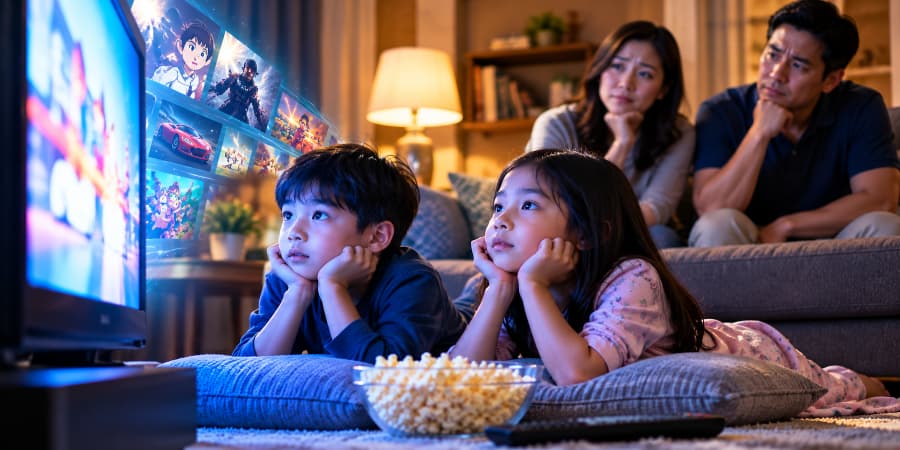
Every parent has done it: put on a show so we can rest for a few minutes, and sat beside our child while it plays. It feels like time together. A new study suggests that, for a toddler's brain, it is not quite the same as reading a book on your lap or building a puzzle with you.
What the researchers did
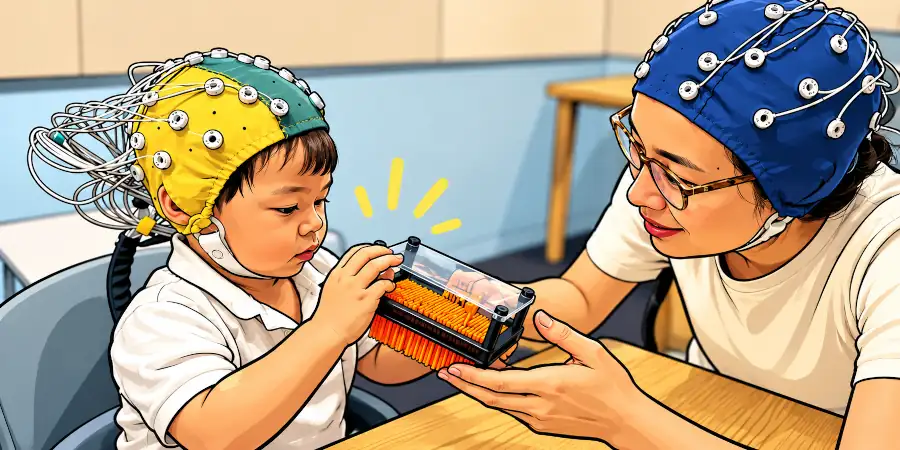
A team from Northwestern University in Chicago, led by Dr. Elizabeth Norton, studied 49 toddlers, aged 2 to 3½, together with their parents. The children, who had a range of language abilities, some with autism, wore soft, stretchy caps that recorded their brain activity (EEG) while they did ordinary, everyday activities: reading interactive books, solving puzzles together, and watching a movie beside their parent.
The researchers then went through the recordings frame by frame, marking the moments when parent and child were truly engaged with each other, and compared them with the movie moments.
What they found
- Reading and playing together lit up the brain differently. During engaged moments, toddlers showed brain patterns linked to alert attention and social engagement.
- The movie didn't do the same, even when the children looked completely absorbed in it. Looking absorbed and being engaged turned out to be different things.
- Every child's brain responded. Children with autism or language delays engaged with their parents less often, but when they did, their brains responded in the same way. That is a hopeful finding for every family.
The study was published in October 2026 in the journal Brain and Language. It is a small, early study that shows what happens in the brain during these moments, not long-term effects, and the researchers are still analyzing the parents' brain data.
It fits what we already knew
This new study adds to earlier research pointing the same way. A 2018 study from MIT and Harvard found that what mattered most for young children's language brain activity was not simply how many words they heard, but how many back-and-forth conversational turns they had with adults. And for years, the American Academy of Pediatrics has advised parents of young children to keep screen time limited and, when children do watch, to watch with them and talk about what they see.
The common thread is simple: children learn best in relationship. A screen can talk to a child. Only a person can talk with one.
Six simple ways to put this into practice
- Read together every day, even for ten minutes. Point at pictures, ask "What's that?", and wait for an answer. The talking around the book matters as much as the words in it.
- Play on the floor, at their level. Puzzles, blocks, pretend cooking. Follow your child's lead and talk about what they're doing.
- Take turns in conversation. Ask a question, then really wait. A toddler's answer may be a word, a gesture, or a giggle, and every one counts as a turn.
- If there's a screen, make it shared. Sit together, pause, and talk about the story: "Why is he sad? What will happen next?"
- Use the in-between moments. Bath time, cooking, the jeepney ride. Name things, sing, count, and ask questions.
- Put your own phone down. Children notice where our attention goes. A few fully present minutes beat an hour of half-attention.
How this connects to Eastbridge
At Eastbridge, we believe a child's first and most important teachers are their parents, and that every child carries God-given gifts waiting to be discovered. Those gifts are often first noticed in exactly these moments: a child who can't stop asking about the pictures in a book, or who builds the same puzzle again and again. That is also why Eastbridge keeps screens to a minimum in school: no smartwatches, cellphones, or tablets for our students. In our classrooms, children read, play, and talk face to face with their teachers and classmates, and our small classes let teachers do what this study shows matters at home: talk with children, not just at them. Read: Discovering and Nurturing Your Child's Gifts →
Long before brain scans, Scripture told parents to teach their children "when you sit at home and when you walk along the road, when you lie down and when you get up" (Deuteronomy 6:7, BSB). It was always meant to happen in everyday moments, face to face. Science is simply catching up.
Sources: Northwestern University, "Why story and play time really matter" (October 2026), reporting on "Toddler EEG power reflects behavioral social engagement state during naturalistic parent-child interaction," Brain and Language (2026), DOI 10.1016/j.bandl.2026.105848 · Romeo, R. R., et al. (2018). "Beyond the 30-million-word gap: Children's conversational exposure is associated with language-related brain function." Psychological Science, 29(5) · American Academy of Pediatrics, "Media and Young Minds" (2016).
Every child has gifts worth discovering.
Visit Eastbridge, meet our teachers, and see our classes in action.
Mas gusto n'yo po bang mag-message?