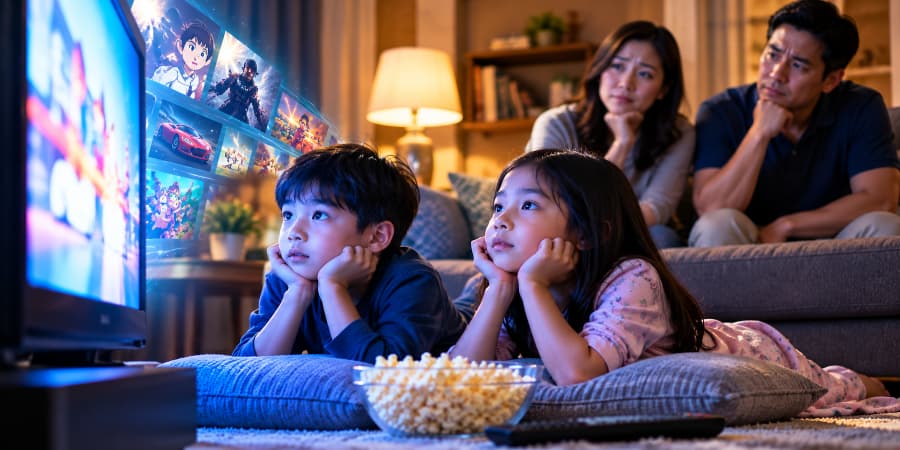
Rest and recreation are good for all of us, children included. But not every kind of recreation is good for the people who enjoy it. Surprisingly, the one we suspect least may be among the biggest threats to our families: the screen that is always on.
A note on this revision: I first wrote this in 2007 about television. Since then, phones, tablets, and streaming have made screens far more personal and far more constant. Everything below about TV applies to them too.
What the research found
Over the years, studies have linked heavy screen use in children with a range of concerns:
- Lower school performance. A 2006 study of about 4,500 middle school students, published in Pediatrics, found that more weekday screen time was linked to poorer grades, and that watching R-rated content was especially harmful. Boys were more affected than girls.
- Aggression later in life. A University of Michigan study that followed children for 15 years (Huesmann and colleagues, 2003) found that heavy viewing of TV violence in childhood predicted more aggressive behavior as young adults, and that girls were affected as well as boys.
- Unhealthy eating and weight gain. Children's advertising is carefully designed to create lifelong customers, and long hours of sitting take the place of active play.
- Poorer sleep, especially when screens are in the bedroom or used late at night.
- Habits that are hard to break. In a 2002 Scientific American article, psychologists Robert Kubey and Mihaly Csikszentmihalyi described how heavy viewing can look a lot like dependence: wanting to cut back, failing to, and giving up other activities to keep watching.
Kubey and Csikszentmihalyi were careful to add that television itself is not the enemy. It can teach, amuse, and even inspire. The problem begins when we sense we should watch less, yet find ourselves strangely unable to.
What about "good" shows?
Even educational programs are not a substitute for real interaction. Educator Jane Healy, in her book Endangered Minds, raised concerns that fast-paced programming, even well-meant children's shows, may train young minds to expect constant stimulation rather than to sustain attention. Newer research points the same way: young children learn best from people who talk with them, not from a screen that talks at them.
The deeper concern is not any single show. It is what screen time pushes out: reading, playing, imagining, talking at the dinner table. A screen feeds a child a steady stream of information, often with little room left to think, wonder, or create.
How a screen can come between parent and child
In her book Glued to the Tube, Cheryl Pawlowski argued that television can quietly take over roles that belong to parents: mentor, hero, and friend. When children spend more time listening to a screen than to their mothers and fathers, they begin to look to the screen for their role models and values.
Many of us work long hours to provide for our families, and it is tempting to be thankful for a tireless babysitter that never complains. But a screen cannot love our children, correct them, or pass on our faith and values. Only we can.
Six simple steps for your home
- Keep screens out of bedrooms, especially at night.
- Set screen-free times: meals, the first hour after school, and the hour before bed.
- Watch together when your children do watch, and talk about what you see.
- Choose content carefully. Know what your children watch and play, and why.
- Fill the space with books, games, chores, sports, music, and time outdoors.
- Model it yourself. Our children notice where our eyes go.
What Eastbridge does
At Eastbridge, we keep screens to a minimum: no smartwatches, cellphones, or tablets for students in school. Our children learn with books, pens, and paper, and face to face with their teachers. Pens and Paper: Why Eastbridge Never Left → · Why Can't They Read the Board? →
Scripture gives us a good filter for everything our children see: "whatever is true, whatever is honorable, whatever is right, whatever is pure, whatever is lovely, whatever is admirable—if anything is excellent or praiseworthy—think on these things" (Philippians 4:8, BSB). When our children know more brand logos than names of plants and birds, it may be time to turn the screen off and step outside together.
— Pastor Gerry Limoso, Founder and President, The Eastbridge School. First written in 2007; revised in 2026.
Sources: Sharif, I., & Sargent, J. D. (2006). Association between television, movie, and video game exposure and school performance. Pediatrics, 118(4). · Huesmann, L. R., et al. (2003). Longitudinal relations between children's exposure to TV violence and their aggressive and violent behavior in young adulthood. Developmental Psychology, 39(2). · Kubey, R., & Csikszentmihalyi, M. (2002). Television addiction is no mere metaphor. Scientific American, 286(2). · Healy, J. M. Endangered Minds: Why Children Don't Think and What We Can Do About It. · Pawlowski, C. Glued to the Tube: The Threat of Television Addiction to Today's Family.
Raising children with faith, love, and structure.
Visit Eastbridge, meet our teachers, and see our classes in action.
Mas gusto n'yo po bang mag-message?