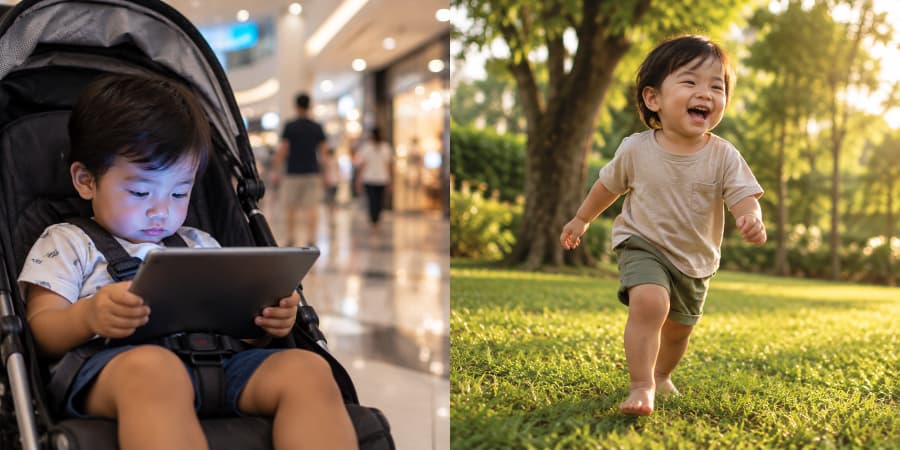
For two decades, the world ran a giant experiment on its children. The "classroom of the future," we were told, was a paperless one: tablets instead of textbooks, typing instead of handwriting, a screen in every schoolbag. The most tech-forward nations on earth — Denmark, Sweden, Norway — went furthest and fastest.
Today, those same nations are making a dramatic U-turn. Not out of nostalgia — out of evidence. And for families at Eastbridge, the most striking thing about this global reversal is how familiar the destination looks: from the day smartphones first appeared, our students have simply never brought them — or smartwatches — to school at all. No surrender baskets at the gate, no confiscation drawer in the office: the devices stay home. And we are determined to keep it that way through Grade 10.
The world is turning back toward a road we never left. Here is why.
What the Brain Does When the Pen Moves
Some of the most compelling evidence comes from Norway. Researchers Ruud Van der Weel and Audrey Van der Meer at the Norwegian University of Science and Technology used high-density EEG caps to watch students' brains at work, comparing handwriting against typing on a keyboard.
The difference was dramatic. When students wrote by hand, their brains showed widespread functional connectivity — different regions lighting up and talking to each other in the frequency patterns associated with learning and memory formation. Typing produced nothing comparable. Pressing a key is the same mechanical act whether the letter is A or Z; shaping letters by hand demands precise, varied, controlled movement — and that rich stream of touch and motion is what anchors information in a child's mind.
"The spatiotemporal pattern from visual and proprioceptive information obtained through the precisely controlled hand movements when using a pen contribute extensively to the brain's connectivity patterns that promote learning," the researchers reported in Frontiers in Psychology.
In plain parent language: the pen is not old-fashioned. The pen is a learning machine — and the keyboard, for a developing brain, is mostly a speed machine. Speed is not what childhood learning needs most.
The PISA Alarm — and the Nordic U-Turn
Why would the world's digital pioneers reverse course? Because their results came in. International PISA assessments showed worrying declines in reading and mathematics across several Nordic countries — and when officials looked for causes, the heavy digitalization of children's daily lives stood out. Sweden's education ministry began steering schools back toward printed textbooks and handwriting practice. Denmark went further: a national mandate for phone-free environments in its primary and lower secondary schools, covering children aged roughly 7 to 17 — personal devices left at home or surrendered at the door.
"There is a need to reclaim the school as an educational space, where there is room for reflection and where it is not an extension of the teenage bedroom," said Denmark's Minister for Children and Education, Mattias Tesfaye.
That phrase — an extension of the teenage bedroom — names the problem exactly. A smartphone in a pocket keeps a child half-elsewhere: notifications waiting, comparisons running, status to check. Psychologists call it continuous partial attention. Deep learning — the kind where a child wrestles with a hard problem until it yields — requires full presence. A phone in the room competes for that presence, and the phone was engineered by thousands of very clever adults to win.
Danish researchers found something else worth every parent's attention: reports from schools that piloted phone-free days describe hallways coming back to life. When the screens go away, the talking begins — face-to-face conversation, negotiation, play, the ordinary social apprenticeship childhood is supposed to be.
Why Eastbridge Never Took That Road
None of this required a research grant to suspect. It required watching children closely — which is what a school that knows every child does all day. From the time smartphones began arriving in the world's schoolbags, Eastbridge made a decision that occasionally puzzled people: smartphones and smartwatches are not brought to school at all. There is nothing to confiscate, because nothing arrives. School hours belong wholly to books, pens, teachers, friends, play, and prayer — and we will hold that line all the way through Grade 10, precisely the years when a young person's attention, identity, and self-control are still under construction.
The Nordic experts now recommend what our families have long practiced. Denmark's Wellbeing Commission advises no personal smartphone before age 13; Norway is moving toward a minimum age of 15 for social media. The commission's chair, Rasmus Meyer, compared phones in schools to smoking — warning that the moment a child receives a smartphone, it begins to "colonise" their life. Strong words. But any parent who has watched a child disappear into a screen at the dinner table knows they are not too strong.
Let us be clear about what this is not. Eastbridge is not anti-technology — our students learn on the Koobits math platform, and our Wednesday online classes run on a structured virtual classroom. Technology has a place in learning: as a tool in the teacher's hand, at the time the teacher chooses — never as a private world in a child's pocket during the school day. The distinction is everything. The Nordic nations are not burning their laptops; they are re-drawing the boundary between tool and temptation. We drew that boundary years ago.
What Parents Can Do at Home
- Delay the first smartphone. The emerging expert consensus points to age 13 at the earliest — and later for social media. A basic phone for coordination is not the same as a smartphone; the difference is the apps, not the calls.
- Keep bedrooms and mealtimes screen-free. The two places a child most needs rest and connection are the two places the phone raids first.
- Put pens and paper back in their hands. Journals, letters to Lola, copied Bible verses, drawn maps. The Norwegian research suggests the hand teaches the brain — give the hand something to do.
- Let them be bored sometimes. Boredom is the doorway to imagination. A child rescued from every dull moment by a screen never finds out what their own mind can build.
The Road Less Traveled Is Filling Up
For years, a smartphone-free campus could sound quaint — a Christian school in Montalban holding out against the future. It turns out we were not behind the times. We were early. The most educationally advanced, most digitally fluent nations on earth have now examined the evidence and legislated their way back to pens, books, and phone-free classrooms — back, in other words, to the kind of childhood Eastbridge never stopped protecting.
We did not need the research to tell us that children learn best when they are fully present — to their teacher, to their friends, and to God. But it is good to know that when the world finally checked the data, the data agreed.
Want to see a smartphone-free school day for yourself?
Visit Eastbridge, see our classes in action, and watch what happens when children are fully present.
Schedule a campus visitSend us a message