In early October 2026, high school students across France walked out of their classrooms to protest overcrowded schools, teacher shortages, and crumbling buildings. Within days, some of those protests had turned violent: garbage bins set on fire, bus shelters smashed, clashes with police. Thousands were arrested, most of them teenagers.
Their concerns were real. Many schools there truly are under-resourced. But somewhere between the grievance and the fire, something went wrong. And it raises a question every parent, here in the Philippines too, should be asking: Who is shaping what our children believe, and how they act on it?
The new "teachers" in our children's lives
A generation ago, a child's convictions were formed mostly by parents, teachers, church, and neighbors: people who knew the child and would still be there tomorrow. Today, a twelve-year-old with a phone can hear from thousands of voices before breakfast: influencers, online movements, strangers in comment sections, and algorithms designed to keep them scrolling.
Those voices are rarely evil. But they share three traits worth noticing: they don't know your child, they aren't responsible for your child, and they are often rewarded for outrage. Content that makes young people angry or afraid spreads faster than content that makes them wise.
The phone-based childhood
In his widely discussed book The Anxious Generation (2024), social psychologist Jonathan Haidt argues that childhood shifted in the early 2010s from "play-based" to "phone-based," and that rising anxiety and loneliness among young people followed. Not every researcher agrees on how strong the link is; some argue the evidence is still mostly correlational. But few parents need a study to notice what happens to a child's mood, sleep, and patience after hours on a screen.
When parenting is redefined
The harder truth is closer to home. Many of us are busier than our parents were. Some of us work far from home, or abroad. Some of us have quietly handed formation over to the school, the yaya, the tablet, or the youth group, hoping someone else will do the forming.
Others have swung the other way, afraid to say "no," wanting to be our children's friend more than their parent. Decades of research on parenting point to the same balance: children do best with warmth and clear structure together. Not harshness without love, and not love without limits.
"These words, which I command you today, shall be on your heart; and you shall teach them diligently to your children, and shall talk of them when you sit in your house, and when you walk by the way, and when you lie down, and when you rise up."
Deuteronomy 6:6–7 (WEB)
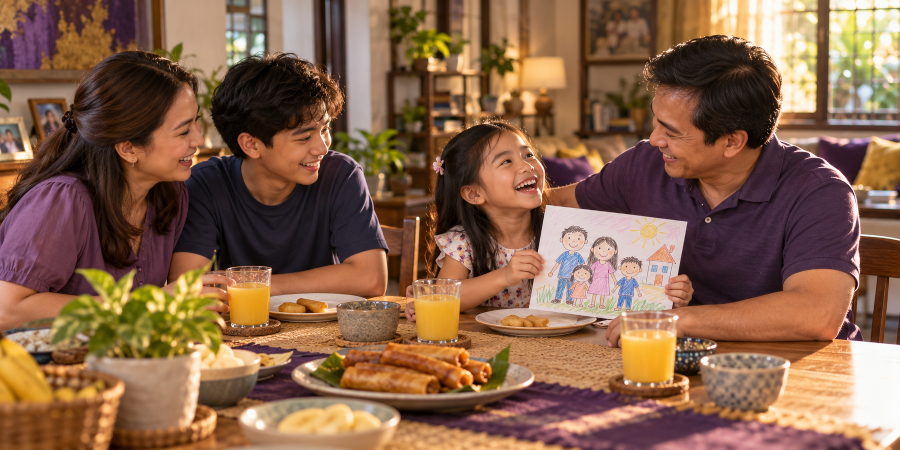
God's design was never that formation would happen in one weekly lesson. It happens in ordinary moments, at the dinner table, in the car, at bedtime, by the parents who are present for them.
The goal: children who think well, not just children who obey
Our children will grow up with convictions. They will see injustice and want to respond, and that is a good thing. The question is whether they will learn to think carefully, speak respectfully, and act constructively, or simply absorb whatever is loudest.
A child formed well can disagree without destroying, question without contempt, and stand for something without being used by someone.
Six things parents can do this week
- Know their voices. Ask who they follow and watch, then look for yourself. Curiosity works better than spying.
- Ask, "Where did you hear that?" Teach them to check a claim before they share it, and model it yourself.
- Protect phone-free zones. Dinner and bedrooms are the two places that matter most.
- Practice respectful disagreement at home. Let them argue a position, then ask them to explain the other side fairly.
- Give real responsibility. Service, chores, and helping others give young people a healthy outlet for their desire to make a difference.
- Pray with them, not just for them. Children remember the faith they saw lived out at home.
Where a school fits
No school can replace a parent. But the right school can stand beside you. At Eastbridge, our campus is smartphone-free, our classes are small enough that teachers know every child, and in Junior High, our LIFE Program gives students a dedicated subject for building character and resilience. We see ourselves as partners with parents, never substitutes.
The voices shaping our children will only get louder. Let's make sure ours are among the clearest, warmest, and most trusted they hear.
Looking for a school that partners with parents?
Visit Eastbridge, meet our teachers, and see how we help form children who think well.
Book a Campus VisitMas gusto n'yo po bang mag-message? Chat with us on Facebook