"Mahal ko naman sila, bakit parang hindi nila ramdam?" Many loving parents and spouses ask this quietly. The answer may be simpler than we think: we are speaking love in our own language, not theirs.
The Shoes in the Box
An illustrative story, drawn from the kind of moments many Filipino families know well. Names and details are not of a real family.
Mang Ramon drove a delivery truck six days a week. On many nights he came home after the children were asleep, ate cold rice by the stove, and left again before sunrise. He never complained. In his heart, every extra trip was a love letter to his family.
His daughter Bea was fourteen. Her school had a recognition program on a Friday afternoon, and she had been chosen to give a short speech. She asked her father twice if he could come. "Susubukan ko, anak," he said. Both times, she believed him.
On the day of the program, she kept looking at the door. Her mother was there, smiling and waving. The seat beside her mother stayed empty.
That night, Mang Ramon came home carrying a shoebox. Inside were the white sneakers Bea had pointed at in the mall weeks before. He had taken an extra trip that week to pay for them. He placed the box on her bed and waited for her smile.
Bea said thank you. Then she closed her door and cried.
Mang Ramon sat outside on the bangko, confused and hurt. "Ano pa ba ang kulang?" he asked his wife. She was quiet for a long moment. Then she said softly, "Hindi sapatos ang hinahanap niya, Ramon. Ikaw."
The next Saturday, he did something he had not done in years. He woke Bea early, and the two of them walked to the bakery for pandesal. They took the long way home. He asked about her speech. She recited it for him, right there on the sidewalk. He clapped too loudly. She laughed and told him to stop.
Bea still wears those white sneakers. But ask her what she remembers from that year, and she will tell you about the Saturday walks.
Mang Ramon loved his daughter all along. He was just saying it in a language she could not hear.
Love that is sent but not received
Dr. Gary Chapman, a Christian marriage counselor and author of The 5 Love Languages®, noticed this pattern after years of listening to couples. People who sincerely loved each other still felt unloved, because each one was expressing love in the way they preferred to receive it.
He described five common "languages" of love. Here is how they often look in a Filipino home:
Words of affirmation. "Proud ako sa 'yo." "Salamat sa luto mo, ang sarap." A short note in a lunchbox. For some people, kind words are oxygen, and harsh words cut very deep.
Quality time. Undivided attention. Sabay na kumain without the TV. A walk, a long kwentuhan, a parent who actually watches every school program.
Receiving gifts. Not about price. Pasalubong, a favorite snack remembered, a small thing that says "naalala kita."
Acts of service. Fixing the leaking faucet, ironing the uniform, helping with the project without being asked. For these people, actions truly speak louder than words.
Physical touch. A hug at the gate, an arm around the shoulder, holding hands while praying, a pat on the head before sleep.
Where the misunderstandings begin
Most family hurts are not caused by a lack of love. They are caused by love that misses its target.
A wife who longs for quality time may feel lonely even if her husband works hard to provide everything. The husband, meanwhile, feels unappreciated because his acts of service go unnoticed. Both are tired. Both are hurt. Both are sincere.
A teenager whose language is words of affirmation may hear only the corrections and never the pride a parent quietly feels. A younger child who needs physical touch may act out simply because hugs stopped when "malaki ka na."
Once we understand this, many arguments change from "Hindi mo ako mahal" to "Ah, ganito pala ang kailangan mo."
A lens, not a label
A word of balance. The love languages are a helpful way to start a conversation, not a scientific diagnosis. A 2024 review by relationship researchers (Impett, Park, and Muise, in Current Directions in Psychological Science) found that most people value all five expressions of love, not just one. Think of it less like a single native tongue and more like a balanced diet: everyone needs all five, but each person may have a favorite dish.
So please don't box your child in. "Ay, gifts lang ang love language niyan" is not the lesson. The lesson is this: learn what fills each family member's heart most, and keep giving all five generously.
Scripture puts it plainly:
"My little children, let us not love in word, neither in tongue; but in deed and in truth."
1 John 3:18 (KJV)
Love that is true takes the trouble to be understood.
Discover your family's love languages
Dr. Chapman's official website offers a free quiz. Try it this week, then compare results over merienda. Expect some surprises and a lot of laughter.
For husbands, wives, and teens
The official Love Language® Quiz is free and takes a few minutes. At the start, it asks how you describe yourself, so each person picks the version that fits: couple, single, teen, or child.
Take the official quizFor younger children
Young kids can't always put it into words yet. The official site has a simple guide for parents of children ages 5 to 8, with a fun drawing exercise to discover how your child sees love.
See the guide for young kidsA one-week family challenge
Each day this week, choose one person at home and love them in their language, not yours. A note for the one who loves words. A walk for the one who loves time. A favorite merienda for the one who loves gifts. A finished chore for the one who loves service. A long hug for the one who loves touch.
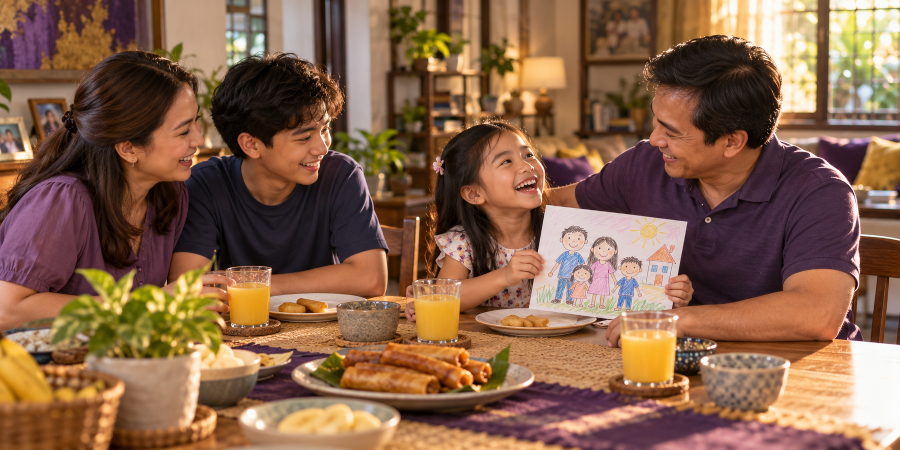
Then watch what happens at your dinner table.
At Eastbridge, we believe children learn and grow best when they feel known and loved, both at home and in the classroom. That is why we see parents as partners, not spectators.
If you're looking for a school that cares about your child's heart as much as their grades, we'd love to meet your family.
Schedule a campus visitSend us a message