In an earlier article, "Discovering and Nurturing Your Child's Gifts," I wrote about our duty as parents to discover the gifts God has placed in each of our children. If we want our children to grow into everything God designed them to be, few things are more worth our time. But discovery is only the first part of that responsibility. The second part is nurturing, and that is what I want to talk about here.
A lesson from the dog trainer
Scripture often points us to ordinary things in nature to teach lasting truths. Solomon tells the sluggard to "go to the ant" and consider her ways (Proverbs 6:6, KJV). Here is a humbler example. Any dog trainer will tell you that you cannot teach a dog a new trick unless you reward the right behavior with something good: a treat, a pat on the head, a scratch behind the ears. Psychologists call this positive reinforcement.
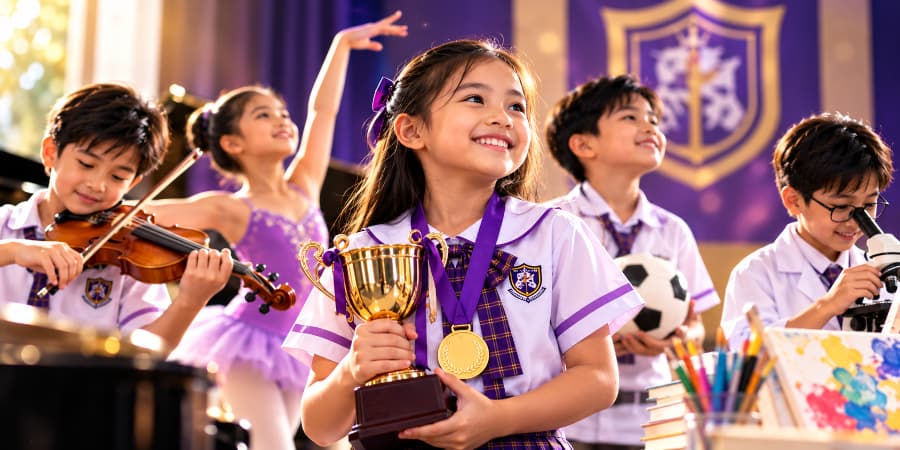
With children, recognition does far more than it does for a dog. For a child, an award is not just a treat. It is a message: someone noticed what you did, and it mattered. At Eastbridge, we call our awards a celebration of gifts.
Five things recognition does for a child
- It builds a sense of significance. A child who is recognized learns that he matters as a person, and that what he does can make a difference to the people around him.
- It shows a child what she is capable of. Recognition makes a gift visible to the child herself. Once she sees that using it well leads to good things, she is motivated to do more.
- It teaches that effort has levels. When awards are given for real achievement, a child begins to connect the level of recognition with the level of effort. He learns that not trying usually means not being recognized, and that showing up and participating is where everything begins.
- It teaches healthy competition. Handled well, a child learns that winning is not everything, yet it still means something more than just taking part. And losing is not a disgrace. It shows a child where his limits are, which keeps him humble. Few things are more harmful than a person so full of himself that he thinks he is Superman.
- It turns losing into a lesson in overcoming. A wise parent or teacher can use a loss as a chance to teach that setbacks are often temporary. Losing invites a child to look honestly at what happened, and then either take up the challenge again or wisely change direction.
Why Eastbridge gives awards in every intelligence
When awards go only to the top few in academics, a child who is not strong in grades can quietly conclude that he is "not bright," and the adults around him may stop looking for anything else. Some children find their gifts on their own, or are lucky enough to have someone notice. Many others grow up never knowing what they could have done, simply because no one ever recognized it.
At Eastbridge, we use Howard Gardner's Multiple Intelligences as a discovery framework, and we add a ninth, Spiritual Intelligence. Through academics, play, music, drama, sports, nature, and hands-on work, our teachers watch for each child's strengths, and our parent-teacher conferences share what they find. Then we recognize those gifts with awards in every intelligence, not only for academic rank. See the nine intelligences →
Does giving many awards make each one mean less? I don't believe so. Your child may never be a scientist like Einstein or Newton, but she may become a dancer like Anna Pavlova if her gift is bodily-kinesthetic. He may never write novels like Tolstoy or Hemingway, but he may become a fine musician. Each of those gifts deserves to be noticed. Adults have the Nobel Prize and the Oscars to honor excellence in very different fields. Children need recognition even more.
Recognizing gifts at home
You don't need a trophy to do this well. A few simple habits go a long way:
- Be specific. "You kept trying that math problem until you got it" says more than "Good job."
- Praise effort and growth, not only results. Children keep at what we notice them working hard on.
- Notice the quiet gifts. Kindness to a younger sibling, a careful drawing, a song made up in the shower. These count too.
- Celebrate as a family. Put the drawing on the wall, tell Lola about the medal, pray together and thank God for the gift.
- Handle losses gently. Ask, "What did you learn?" before "Why did you lose?"
A celebration of excellence
I first wrote this article as Eastbridge prepared for its very first Recognition and Moving-Up Program. Since then, celebrating every child's gifts has become one of our school's traditions.
We are made in the image of a God who is Himself excellent. Scripture tells us, "whatsoever things are of good report … think on these things" (Philippians 4:8, KJV). Discovering and recognizing a child's gift is surely a thing of good report. We may sometimes have to accept mediocrity as a fact of life. But we will always celebrate the best of what the Lord has given, especially when it has the potential of one day becoming great.
— Pastor Gerry Limoso, Founder and President, The Eastbridge School. First written in 2007; revised in 2026.
Every child has gifts worth discovering.
Visit Eastbridge, meet our teachers, and see our classes in action.
Mas gusto n'yo po bang mag-message?