
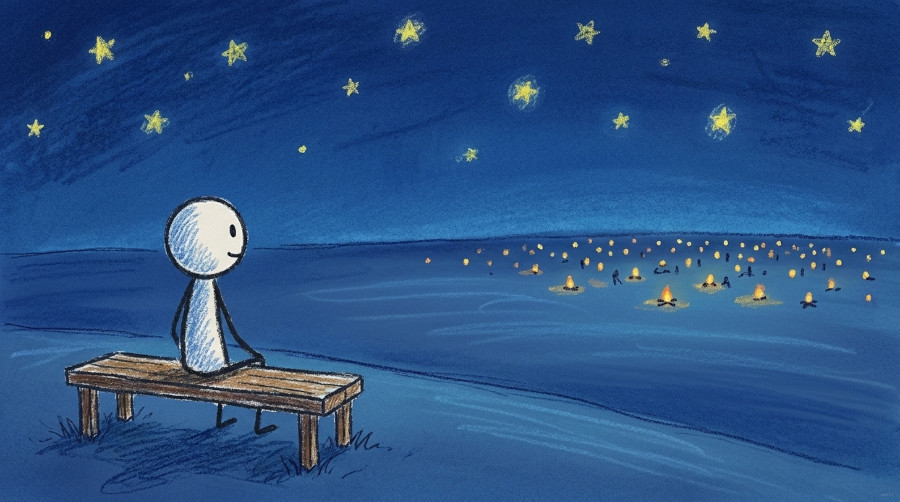
When Jesus heard what had happened, he withdrew by boat privately to a solitary place...When Jesus landed and saw a large crowd, he had compassion on them and healed their sick (Mat 14:13-14 NIV).
The news hit Jesus like a punch to the gut. His cousin, the man who had prepared the way for His entire ministry, was dead, brutally executed simply for speaking the truth to a king drunk on his own power. The quiet desert places that had always been His refuge probably called out to Him. All He wanted was to be alone, to let the waves of sadness wash over Him without the noise of the crowd. This was a moment for private grief, a sacred space that most of us understand deeply. When our hearts are heavy, or when we want to celebrate a personal victory with only our closest family, we crave solitude. We retreat, we lock our doors, and we guard that space like a treasure because sometimes, it's the only thing keeping our sanity intact.
Yet, the story in Matthew 14 reveals a remarkable twist in Jesus’ character. He sought privacy, but He never became a prisoner of it. Even as He tried to slip away to a desolate place, the multitudes followed Him on foot. Anyone else would have been annoyed, would have sent them away with a harsh word. But Jesus, seeing their need, was moved with compassion. He cut His own grieving process short to heal their sick and feed their hunger. It is a powerful lesson that our own pain does not give us a license to ignore the needs right in front of us. For Jesus, the right time to do right was always right now. He teaches us that kindness is not something to be postponed simply because we feel sad. It is a reminder that we are not the center of the universe; the needs of others often hold a higher claim on our time than our own feelings. A preacher once said, "We are most like God when we are most aware of the needs of others." He did not wait until He felt better to be a blessing; He blessed them in the middle of His own storm.
Jesus’ actions challenge our modern obsession with "me time" and personal boundaries. Yes, privacy is vital for our health, but when the opportunity to help arises, we shouldn't hold back just because we are tired or hurting. Think of a farmer who just lost a portion of his crop to a flood. Does he stop working, or does he immediately start planning and planting for the next season? There is a time for mourning, but there is also a time for action. Jesus knew that His sorrow would not be numbed by isolation but would be transformed by service. He was teaching us to be like a bamboo tree, which can bend low in a storm but still provides shade and shelter to those who come near it. "What is the right time to do good?" the philosopher asked. "When you see a need." In that moment, Jesus didn’t lecture the crowd about His grief; He gave them bread. He gave them hope. And in doing so, He showed us the secret to true healing—it is found not in turning inward, but in reaching outward.
This narrative forces us to ask a difficult question about our own lives. How often do we postpone a kind word, a helping hand, or a forgiving spirit because we are "just not in the right headspace"? We hide behind our privacy as if it were a wall of ivory, and we wait for the perfect conditions to be a blessing. But the truth is, the perfect conditions never come. If Jesus had waited until He was over His grief, five thousand people would have gone hungry that day. He looked past His own pain and saw theirs, and He acted. If Jesus Christ operated like that, always ready to meet the need of the moment, I shudder to think where I would be. I would still be lost in my own selfishness and sorrow, with no one to turn to. He didn't just talk about love; He lived it, even when it was inconvenient. The simple truth is, the world is full of hurting people, and we are all the hands and feet of something greater. We don't have to wait until we have our own lives perfectly sorted out to help another. In fact, it is often in the act of helping others that we find our own lives being sorted out.


