
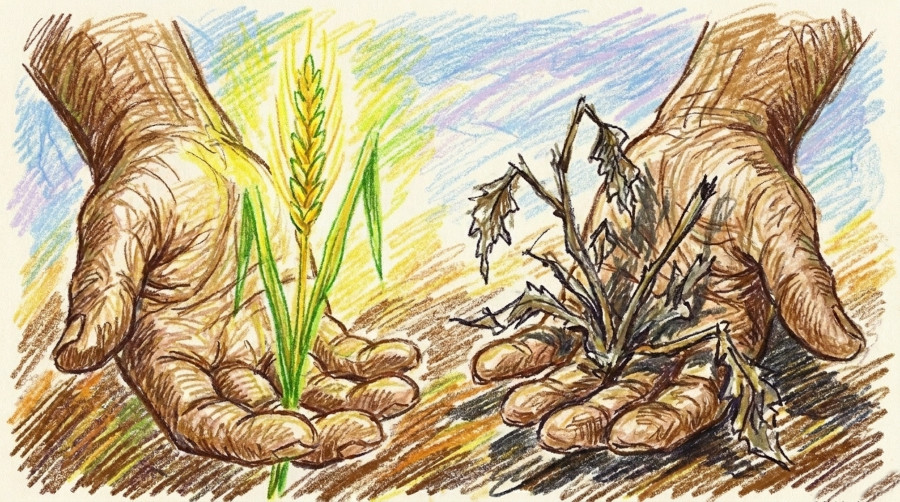
"But while everyone was sleeping, his enemy came and sowed weeds among the wheat, and went away" (Mat 13:25 NIV).
Jesus tells three stories in Matthew 13:24-43 that runs along a similar line. The first one is about a farmer that sows good seed in his field, but while everyone sleeps, an enemy creeps in and sows weeds right among the wheat. When the servants spot the problem, they’re ready to charge into the field and rip everything out. The farmer stops them cold. Let both grow together until the harvest, he says, because in your eagerness to destroy the weeds, you might uproot the wheat as well. At harvest time, the reapers will separate them properly. Jesus later explains the parable plainly: the field is the world, the good seed represents the sons of the kingdom, the weeds are the sons of the evil one, and the harvest is the end of the age.
Then the second and third stories talks about how big things come from small beginnings. Jesus compares the kingdom of heaven to a small portion of yeast that works all through sixty pounds of flour and a mustard seed that a man plants in his field. Any Filipino who has seen a malunggay or a sampaloc tree dominate a yard knows exactly what this means. That tiny seed, smaller than a button, becomes a tree large enough for birds to perch in its branches. Our own lives follow the same pattern. That first halting prayer muttered in traffic, that first awkward attempt to crack open a Bible you barely understand, that one small decision to forgive a friend who wronged you, it feels almost laughable at the start. But the kingdom takes root in exactly those forgotten, soil-like moments. As the novelist Victor Hugo once wrote, “There is nothing like a dream to create the future.” The smallest seed of a God-ward habit holds within it a harvest you can’t yet see.
But even small beginnings have their troubles. Jesus doesn’t sugarcoat the fact that weeds get planted. In the Philippine setting, think of it like a backyard kamote patch where the morning glory vines creep in unnoticed at night. You wake up one morning and realize something else is drinking the water and stealing the sunlight meant for your crop. In the same way, our good intentions get crowded out by competing voices, the pull of social media comparison, the silent resentment that wraps around a relationship and refuses to let go, or the secret sin we thought we had buried long ago. These are the things that compete for sustenance and hinder growth. The surprise of the parable is that the farmer doesn’t send his workers out with machetes right away. Sometimes ripping out a problem prematurely causes more damage than leaving it until the roots have matured enough to be distinguished.
This leads to a remarkably practical insight about helping small things grow: the answer surprisingly isn’t always to eliminate every weed immediately. Adversity, when handled properly, can drive roots deeper into the soil of faith. A young person who faces peer pressure and chooses integrity doesn’t become strong despite the pressure but often because of it. The resistance of the weed forces the wheat to anchor itself. The apostle Paul understood this when he wrote in 2 Corinthians 12 that God’s power is made perfect in weakness. Our missteps and the presence of evil around us don’t automatically ruin the harvest. They can become the very circumstances God uses to mature us, teaching us dependence on the strength that sustains the good plant.
Ultimately, the parable asks us to trust the strength of the farmer who ensures the harvest. “Let both grow together,” he says, because he knows his reapers will handle the sorting at the proper time. We are not the ones who execute final judgment, and that is a deep relief. God will sort them out in the end. The question that lingers is whether we can trust the harvester. The farmer in the story is not panicked. He doesn’t second-guess his decision. He knows his field, he knows his seed, and he knows his weeds. When the sun beats down and the rains flood the field, his confidence is the only thing that keeps the servants from doing something rash. Our calling is to grow where we’re planted, even when we feel surrounded, and to leave the final sorting to the only Judge who reads every root system perfectly.
How then do we live in the messy middle? By fixing our eyes not on the weeds but on the farmer who has never lost a harvest. We wake up each morning, tend the small shoots of faith God has given us, pull out what we can clearly identify as harmful, and entrust the ambiguous struggles to His timing. Your small beginning, beleaguered though it may feel, is heading toward a harvest you would not trade for anything.


